Friday, June 12, 2020

Homeland Defense Radar System Will Not Protect Hawaii From a Nuclear Attack


Senator Mazie Hirono is Wrong and Needs a Lesson on Missile Defense: Homeland Defense Radar System Will Not Protect Hawaii From a Nuclear Attack
by Lynda Williams
After more than a year of meetings with Neighborhood Boards and local Native Hawaiian groups, the Missile Defense Agency (MDA) effectively cancelled the proposed Homeland Defense Radar for Hawaii (HDR-H) by not funding it in the 2021 Pentagon budget, the National Defense Authorization Act or NDAA. In addition to facing fierce local protest, MDA cancelled the 2 billion-dollar HDR-H discrimination radar system because the technology is obsolete. Rather than constructing more limited land-based radar systems, the Pentagon is planning to move missile surveillance into space with a Space Based Sensor Layer.
So why is Senator Mazie Hirono fighting so desperately to keep the HDR-H project alive? Hirono, a member of the Senate Armed Services Committee that marks up its own version of the NDAA claims that “HDR-H is part of our country’s critical, layered defense. As the United States continues to confront a range of strategic threats in the Indo-Asia-Pacific region, it is imperative that all Americans are protected by our ballistic missile defense system.”  These claims made in a Star Advertiser article are false on many grounds.
First and foremost, “layered defense,” the MDA strategy to defend the homeland and allies from nuclear missile attack using multiple stages of missile defense, has never been tested in real world scenarios. There is no guarantee that layered missile defense can protect anyone from a nuclear attack but since many of the layers are based in Hawaii, it actually makes Hawaii a greater target.

During first ‘boost phase’ when a missile is launched from enemy territory, the first layer of defense would be to destroy the missile near launch with drone bombs but this technology does not yet exist. Secondly, in the ‘midcourse phase,’ Ground Based Midcourse (GMD) long range interceptors launched from Alaska or California would attempt to destroy the nuclear missiles in space. If these two attempts fail, as the missile approaches its target in its “terminal phase,” medium range SM3-Block 2 interceptors launched from Aegis warships or Aegis ashore systems like the one stationed at the Pacific Missile Range Facility (PMRF) would be deployed. The Aegis SM3-Block 2 interceptor was designed for short and intermediate range targets, not intercontinental-range ballistic missiles (ICBM) so the MDA is currently trying to extend their reach ICBMs in their midcourse phase. They are currently planning to test the extended SM3 in Hawaii in 2020 to intercept an ICBM launched from the Kwajalein Atoll in the Marshall Islands. SM3 interceptors are cheaper than GMD interceptors.
The final layer of defense would be to use Terminal High Altitude Area Defense System (THAAD) interceptors, also stationed at PRMF and used to intercept missiles just before they hit their targets. Radar systems like the troubled Sea based X Band Radar stationed in Hawaii and the proposed HDR-H radars are tasked with tracking the missiles but they have limited range and that is why the Pentagon wants to replace ground based radars with a space based sensor layer. Furthermore, layered missile defense can’t defend against hypersonic (at least five times faster than sound) missiles currently being developed by China and Russia (and the US) in response to US deployment of missile defense systems. The layered missile defense strategy and HDR-H - all of which has cost US taxpayers more than a hundred billion dollars are already obsolete and cannot keep Hawaii safe from nuclear attack. 
 According to the Union of Concerned Scientists “In its current form, strategic missile defense is a waste of resources at best and dangerous at worst. It is not a reliable defense under real-world conditions; by promoting it as a solution to nuclear conflict, US officials complicate diplomatic efforts abroad, and perpetuate a false sense of security that could harm the US public.”


Senator Hirono doesn’t seem to understand why HDR-H is a bad investment. She is unrelenting in her lobbying effort: “Securing full funding authorization for HDR-H was my top priority in the NDAA this year because it will help keep Hawaii safe from external threats. I will continue to advocate for its inclusion in the final, approved package.”
In this time of grave economic uncertainty due to the COVID-19 pandemic, and as unprecedented protests around the country are demanding that the government redirect spending from the police and military to more urgent social needs such as healthcare, education, and the environment, Congress must cut this wasteful, unessential, and dangerous weapon system from the NDAA. We must pursue diplomatic strategies for resolving conflict in the Pacific.
I would be very happy to give Senator Hirono a private lesson on why we must cancel HDR-H.
Sincerely,
Lynda

Please sign and share our petition to CANCEL THE HDRH! Thanks!

Lynda Williams is a Physicist & Science Educator with the Global Network Against Weapons and Nuclear Power in Space (space4peace.org)


Space Alert Article on the Homeland Defense Radar - Hawaii


Saturday, October 12, 2019

The Pentagon Plans to Build a Billion Dollar Radar on Sacred Hawaiian Ground for a Missile Defense System that Doesn't Work and Will Never Work

The Pentagon Plans to Build a Billion Dollar Radar on Sacred Hawaiian Ground for a Missile Defense System that Doesn't Work and Will Never Work


Summary: The Pentagon is planning to build a billion dollar radar system called the Homeland Defense Radar –Hawaii (HDR-H) on Oahu, Hawaii, to track incoming ballistic nuclear missiles as a part of the US Missile Defense system. A preliminary Environmental Impact Statement (EIS) names two possible locations for the 8-story-tall-by-8-story-wide radar station that would take up approximated 160-acres of land: Kuaokala Ridge, adjacent to the Kaena Point Satellite Tracking Station (KPSTS) which is used for tracking satellites and space debris, and two possible sites in the Kahuku Training Area (KTA) on the North shore. An Archeological Survey of the Kauokala Ridge required by The National Historic Preservation Act (NHPA) conducted by Keala Pono Consulting Firm, identified several sites that are of historical and cultural significance in the proposed locations including the Moka’ena Heiau located on the highest elevation on Kaena point.  The HDR-H is part of a larger constellation of missile defense radar systems covering the Pacific that will cost over $4 billion. Lockheed Martin won the contract to design and build the HDR-H. However, scientific organizations such as The Bulletin of Atomic Scientists and Union of Concerned Scientists (UCS) have recently claimed that missile defense has a poor testing track record and is ineffective to protect the US homeland. The final EIS is due in 2020 with construction slated to begin in 2021.

Billion Dollar Expansion of Missile Defense in Hawaii and the Pacific

The Pentagon is planning to build a billion dollar radar system called the Homeland Defense Radar –Hawaii (HDR-H) on Oahu, Hawaii, to track incoming ballistic nuclear missiles as a part of the US Missile Defense system. The 2017 National Defense Authorization Act required the Missile Defense Agency (MDA) to develop and field a “discrimination radar” to improve the defense of Hawaii from ballistic missile threats. “Discrimination” refers to the ability to distinguish actual warheads from rocket debris, countermeasures and decoys, which, according to the Union of Concerned Scientists (UCS), such radar systems are not capable of doing and have never been tested for under real life scenarios. 

The HDR-H would be used to support missile defense systems at the Pacific Missile Range Test Facility (PMRF Barking Sands) on the west side of Kauai that houses an Aegis “Ashore” Ballistic Missile Defense Systems (Aegis BMD). Although the Aegis Ashore system is not currently ‘deployed’ on Kauai for use in warfare, the Pentagon is pushing to “operationalize” it. PMRF has also houses a Terminal High Altitude Area Defense System (THAAD) used to defend against incoming short and medium range missiles possibly from North Korea or China. 

Proposed Locations for Radar Construction and Development

The Department of Defense announced the intention to build the HDR-H June 1, 2018 and initiated a scoping process for determining potential sites in Hawaii. A preliminary Environmental Impact Statement (EIS) names three possible sites for the 8-story-tall-by-8-story-wide radar station that would take up approximated 160-acres of land: Kuaokala Ridge, adjacent to the Kaena Point Satellite Tracking Station (KPSTS) which is used for tracking satellites and space debris, and two possible sites in the Kahuku Training Area (KTA) on the North shore. The preliminary EIS states that if the Kuaokala Ridge site is selected for HDR-H, existing facilities at KPSTS such as the Solar Electro-Optical Observatory would be blocking the radar’s view and would have to be relocated. Additional infrastructure development would also be required. 


The Hawaiian State Legislature proposed a bill (H.B N0. 1396) in 2019 to assist providing the tremendous amounts of energy required for HDR-H with renewable energy sources. The bill is in committee for further action when the legislature reconvenes next year.

Sacred Hawaiian Sites on Proposed Radar Locations

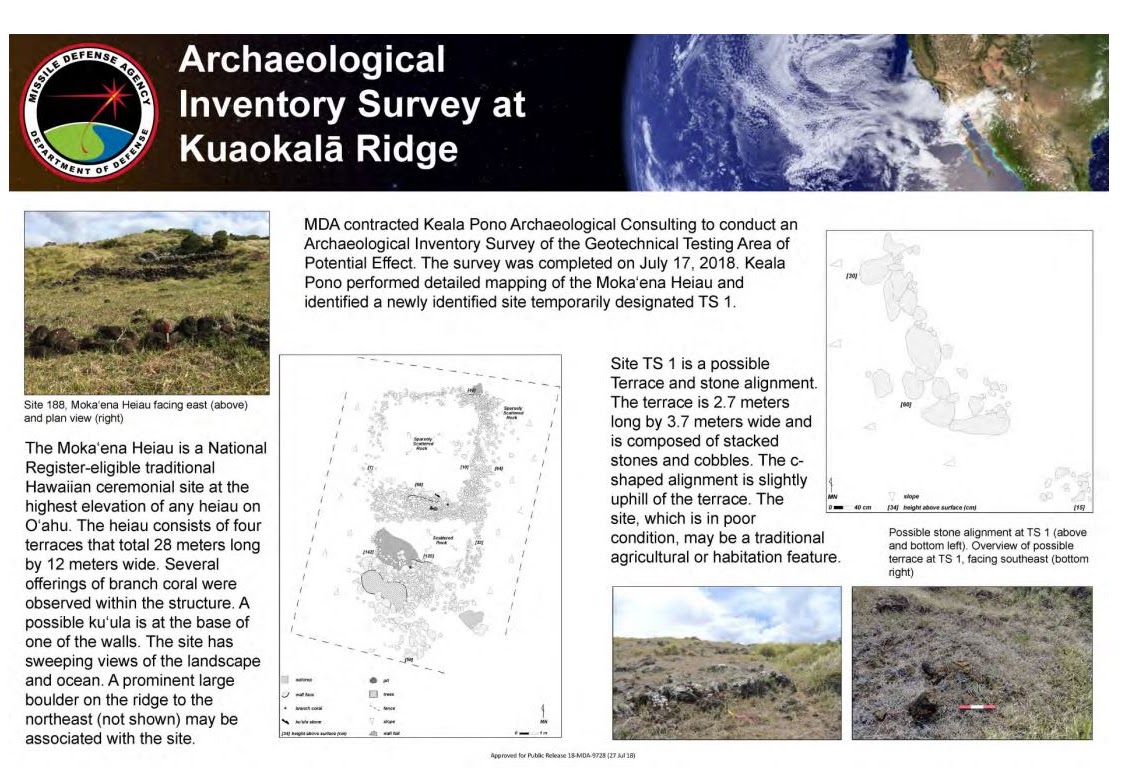
An Archeological Survey of the Kauokala Ridge required by The National Historic Preservation Act (NHPA) conducted by Keala Pono Consulting Firm, identified Moka‘ena Heiau in the Area of Potential Effect (APE) and recommended that it be registered with both the National and Hawai‘i Register of Historic Places. The survey also recommended protecting the Moka’ena Heiau (site 188) with a buffer zone and that access should be made available to the heiau for cultural practitioners and other interested community members. 
Kaena Point on Kuaokala Ridge has both cultural and historical significance to the Hawaiian people and is the site of several sacred sun and wind Heiaus, as described in the Archeological Survey . Historically, it was where the prophet Kaanaana first predicted that Hawaii would lose sovereignty to foreigners in the future. Situated at 1,200 ft. above sea level, this is the highest documented heiau on O‘ahu and its position affords sweeping views of the landscape and ocean. According to the survey, “the Moka’ena Heiau was especially important to the population during the time of Kamehemeha I’s impending invasion of Kaua‘i. The heiau was used as an observation point and early warning place to notify the people of Kaua‘i of Kamehameha’s movement. Following the peace treaty between Kamehameha I and Chief Kaumuali‘i of Kaua‘i, there was no longer a need to use Moka‘ena as a place to sound a warning for the Kaua‘i people. Therefore, the heiau was abandoned. Cultural practitioners shared that the heiau was, and still is, used by people of the indigenous religion, Kānenuiākea, a Native Hawaiian religion recognized by the United Nations International Association for Religious Freedom.” The MDA integrated the recommendations of the Archeological Survey into their plans as shown in this scoping posters available online.


An Archeological Survey has not yet been conducted for the KTA alternative sites and Keala Pono Consulting and DLNR did not respond to requests for information about the KTA sites. It is well documented that the Hanakaoe Burial Platform is a heiau site located in Kahuku, possibly in the project area which was added to the National Register of Historic Places on August 14, 1973. A full survey would need to be conducted to determine if it and other sites are located in the APE.

What is Missile Defense and Why Doesn't it Work?

The HDR-H is part of a larger constellation of missile defense radar systems covering the Pacific that will cost over $4 billion. Lockheed Martin won the contract to design and build the HDR-H which is a technological spin off of their $1.5 billion Long Range Discrimination Radar (LRDR) system being built at Clear Air Force Station in Alaska, to be operational by 2020. A third billion dollar radar system, HDR-P will be deployed somewhere in the Pacific, most likely in Japan in order to complement their recent $2.15 billion purchase of two land based Aegis “Ashore” Ballistic Missile Defense Systems (Aegis BMD), also made by Lockheed Martin.

Both the LRDR and HDR radar systems, along with the Sea-based X-Band Radar (SBX), will
support Ground-Based Midcourse Defense (GMD), the basis of $70 billion US Missile Defense System to protect the US and allies from enemy intercontinental nuclear ballistic missiles (ICBMs). The “Midcourse” part of GMD means that the nuclear missile would be intercepted while it is in space on approach to its target. The MDA GMD system uses 44 ground-based interceptor missiles launched from Vandenberg Air Force Base in California or Fort Greely, Alaska. These interceptors are also ICBMs but instead of carrying nuclear warheads they carry “Kill Vehicles” intended to ram the nuclear warheads and destroy them in space before returning to Earth and reaching their targets.


The Pentagon claims that the new generation of LRDR and HDR-H radar systems will be able to discriminate between war heads and decoys but there have never been any tests in real-world scenarios with countermeasures and decoys. In the aftermath of 9–11, President Bush withdrew from the Antiballistic Missile Treaty (ABM) which was keeping nations from deploying missile defense systems. Bush exempted Missile Defense systems from the oversight and accountability process required by other major high cost military systems. Hence there is no experimental evidence that these massive and expensive radar systems will even work when  'deployed' without testing. 

Recently, Union of Concerned Scientists (UCS) claimed that missile defense has a poor testing track record and is ineffective to protect the US homeland. In their 2016 report Shielded from Oversight: The Disastrous US Approach to Strategic Missile Defense the UCS states “In its current form, strategic missile defense is a waste of resources at best and dangerous at worst. It is not a reliable defense under real-world conditions; by promoting it as a solution to nuclear conflict, US officials complicate diplomatic efforts abroad, and perpetuate a false sense of security that could harm the US public.” Here is a video produced by the UCS that demonstrates the problem with US missile defense managing simple countermeasures. 


Space Based Missile Defense and Weapons

The Missile Defense Agency knows these shortcomings to the existing system land and sea based systems which has meant billions in profits for defense Aerospace contractors Lockheed Martin, Boeing and Raytheon over the past few decades. HDR-H would also be used with a space-based missile defense system being proposed to counter hypersonic missiles currently being developed by the US, China and Russia. The US is proposing a Space-Based Missile Defense system consisting of over 600 satellites equipped with laser weapons at the cost of hundreds of billions of dollars to counter hypersonic missiles. Although Space Command is based on the mainland critical components to space war combat are based in Hawaii and the Pacific. Here is another video produced by UCS explaining why Space Based Missile Defense is not a good idea for planet Earth. 


Whether Missile Defense remains on the Earth or is developed in space, Hawaii will be ground zero for MD missions, though there is plenty evidence it will not be able to protect the Homeland. 

Local Government and Community Response to HDR-H

Following the false missile alert in January 2018, Hawaiian Representative and presidential candidate Tulsi Gabbard called for increased spending on missile defense systems in Hawaii and voted to pass the FY 2019 Department of Defense Appropriations bill that provided critical funding for HDR-H missile defense for Hawai‘i, stating  “This bipartisan legislation provides funding for the Homeland Defense Radar — Hawai‘i which will help defend against complex threats by improving the Department of Defense’s capability to intercept an incoming ballistic missile headed towards our state.” 

Amy Perruso, Hawaiian State Legislature representing District 46 recently sent a letter to the MDA director of Facilities and Deployment, Martin F. Duke, regarding geotechnical testing at the proposed sites: "Yesterday, my office sent a letter to the Missile Defense Agency about geotechnical testing at Kuaokalā Ridge. While people struggle to afford shelter and Hawaiians fight to protect the 'āina, we should ask: when it comes to the militarization of Hawai'i, when will it be enough?"
In her letter Perruso asked, 

"I am concerned about the continued loss of Hawaii's land for military purposes. Currently, our state is facing a housing shortage of over 60,000 units. Our homeless population remains the highest in the nation per capita. Most importantly, Native Hawaiians remain alienated within their homeland. As evidenced by the recent demonstrations on Mauna Kea regarding the proposed Thirty Meter Telescope, the Hawaiian community is rightly seeking to redress their historic disenfranchisement and dispossession from their ancestral lands. One must ask, When it comes to the militarization of the 'aina, when will it be enough?" 

The MDA held public meetings in June 2018 to invite members of the community to participate in the scoping process to prepare a final EIS which is expected to be done at the end of 2020. Long-time Native Hawaiian activist and Mālama Mākua founding member Sparky Rodrigues was present at a public meeting. According to Sparky:

"The USA military continues the attack and invasion of Hawaii. Another state and DLNR sanctioned abuse of conservation lands and sacred cultural sites. Desecration of Hawaii national treasures destroyed forever."

If a permit is granted by DLNR construction is slated to start in 2021, with a completion date in 2023. More rounds of public meetings will be held on Oahu in 2020 after the final EIS is released.

To get a glimpse of what the final EIS might include in regards to health and environmental risks of the HDR-H system, the LRDR final EIS was completed in 2016. The World Health Organization has a report on electromagnetic fields and public health: radars and human health.

For more information visit the HDR-H visit the MDA website: https://www.mda.mil/news/hawaii_eis.html

Full letter from Any Perruso: 


Follow Lynda on Twitter at: @atomiccabaret and Instagram @lyndalovon


Saturday, May 14, 2016

Space Ecology: The Final Frontier of Environmentalism

Mining Space? Space Tourism? Space Debris? ASAT Tests? Weapons in Space?

As humans venture into space to advance both commercial and government interests, it is vital that we also develop rules of the road to protect the environment and access to space for all inhabitants of the planet.  Pollution in circum-terrestrial space due to space debris is an international concern for all nations and corporations with space assets at risk and yet few binding international laws governing the protection of the space environment exist. There is also very little public oversight or participation in policy making for this booming new private business sector that enjoys tax breaks, liability indemnities and other government incentives and protections. Space-Ecology.net is an information and news outlet dedicated to environmental and public policy issues related to space development. Here are some articles I have written on space issues.  More to come! 


Natural Living Magazine


Space Alert!


Peace Review, a Journal of Social Justice, 22.1, Spring 2010


Wednesday, April 13, 2016

US Gold Rush in Space Given A GO with the Space Act of 2015

By Lynda Williams
Published in Space Alert! Spring 2016

This past November 25, while US citizens embarked upon holiday festivities, President Obama quietly signed into law the US SPACE Act of 2015 (The U.S. Commercial Space Launch Competitiveness Act, H.R. 2262), granting property rights to materials that U.S. companies mine from asteroids, the moon and other celestial bodies.  With no public debate or international negotiation, the act unilaterally promotes and empowers the private US space industry to develop and test technologies for exploration and extraction of space resources with little regulatory oversight and tax payer economic incentives.


In addition to granting property rights, the act extends for another ten years the "learning period" for commercial spaceflight companies prohibiting the FAA from imposing any new safety regulations on the industry, the exception being rules that specifically respond to fatal accidents or near misses. The act also extends indemnification for space companies from third party claims in the event of a launch accident. Space companies must carry insurance to cover $500 million in damages but US taxpayers will cover any costs above that up to $1.5 billion. US private space flight companies such as SpaceX, Blue Origin and Bigelow benefit from indemnity protection and claim that without indemnity the risks are too high to develop the private space industry. Other space faring nations such as the UK also cut liability caps with their private space and satellite corporations in order to keep them operating in their countries.

Experts in Space Law are debating whether the Space Act is in violation of international agreements such as the 1967 Outer Space Treaty (OST) or if the space grab has a dangerous potential for fueling future conflict in space and on Earth.  The OST does not allow any nation to claim territorial sovereignty in space and establishes space as a global commons to be shared by all humankind.  In accordance with the OST, the Space Act does not allow U.S. companies to own asteroids, only whatever materials they mine from them.   The exact wording is:  "A United States citizen engaged in commercial recovery of an asteroid resource or a space resource under this chapter shall be entitled to any asteroid resource or space resource obtained, including to possess, own, transport, use, and sell the asteroid resource or space resource obtained in accordance with applicable law, including the international obligations of the United States."  How exactly the US will license asteroid claims or ensure the corporate entitlement to those claims is not spelled out in the Space Act and is yet to be determined.

With thousands of near earth asteroids containing possibly trillions of dollars’ worth of rare metals such as platinum, the industry celebrated the passing of the Space Act as a green light to start staking claims in space with the backing and protection of the US government and military which is expanding its space war fighting capabilities through the US Space Command. “This is the single greatest recognition of property rights in history,” said Eric Anderson, Co-Founder and Co-Chairman, Planetary Resources, Inc., an asteroid mining startup backed by Google billionaires Larry Page, Eric Schmidt and movie mogul James Cameron. “In the future humanity will look back at this bill being passed as one of the hallmarks of the opening of space to the people,” said Rick Tumlinson, Chair of Deep Space Industries, another start up with deep pockets.

Not everyone in the space business is as eager to celebrate. “Russia and China might consider using this as another example of the economic aggression of the U.S. and going ahead of the international law,” says Frans von der Dunk, a space law professor at the University of Nebraska.  In an interview with Bloomberg Law, von der Dunk laid out possible scenarios not covered by any existing law which could lead to serious international conflicts. “What if the company mining an asteroid inadvertently causes a part of that asteroid to get into the orbit of a valuable communications satellite from another nation? Does a liability regime which was not developed for those types of circumstances, apply? Or worse what if an asteroid where to change its original trajectory and starts heading to earth, is there any liability or responsibility involved with that?”   What would happen if a mining company from one nation jumps the claim of another? Who would intervene to resolve the situation? Looking to the future, space mining companies plan to set up factories on asteroids or the moon to manufacture goods or to electrolyze water for rocket fuel, which would very likely involve nuclear powered thermal and energy production. There are no laws in place to regulate or mitigate those risks. According to many legal experts, the Space Act is dangerously incomplete and by signing the act into law, Obama may be granting rights and indemnities to US corporations that he doesn’t have the legal right to give.

With hopes of hitting asteroid pay dirt, the nation of Luxembourg announced on February 3, 2016, that it will be funding research in space mining and directly investing in companies active in the field. The space race to enable private corporations to mine the heavens is now international.

The rush to profit from mining space puts the very legal framework of international space law at risk. Signatories to the OST can withdraw at any time with one year’s notice. If corporate and military interests lobby for the US to withdraw from the OST in order to claim space territories, what will be the consequences? We have seen the missile defense industry explode after the US withdrew from the Antiballistic Treaty (ABM) in 2002. If the US withdraws from the OST, which prohibits weapons in space, will it ignite an arms race in space?


It is yet to be seen how the other 102 signatories of the OST respond to the Space Act and it will surely be high on the agenda when the United Nations Committee on Peaceful Uses of Outer Space (COPUOS) meets in June 2016 in Vienna, Austria.  With growing corporate high stakes in space and the willingness of the US government to unilaterally grant and protect those interests with its military might, it is more urgent than ever for the UN and COPOUOS to expand upon the OST and negotiate a space peace treaty like the Prevention of an Arms Race in Outer Space (PAROS).